Thursday, March 22, 2007

Malawi details

Malawi began recording history between the thirteenth and fifteenth centuries. Descendants of these people kept an oral history until the 1500's when written history was recorded in Portuguese and English. The Bantu established political states and government. When a large slave trade took place, this brought Islam to the country. At the same time Christianity was being introduced by missionaries.

Malawi is one of the world's least developed countries. Malawi's economy is predominantly agricultural with nearly 90% of the population living in rural areas. Agriculture accounts for about 40% of GDP and 88% of export revenues. The economy is dependent on substantial inflows of economic assistance from the IMF, the World Bank, and individual donor nations. The government has faced many challenges including the failure to develop a market economy, improving educational activities, facing up to environment problems, and dealing with the exponential increase in AIDS cases.

Over 60 percent of Malawi’s population live below the poverty line. About 40 % of the population are illiterate. With an economy that is dependent upon agriculture and the rate of population growth more than three times the growth rate of the economy, the economic future is not bright. In 1891 the British Central African Protectorate (known from 1907 until 1964 as Nyasaland), which included most of present-day Malawi, was established.
The population estimates for this country are low, but take into account the effects of excess mortality due to AIDS. The AIDS can result in lower life expectancy, higher infant mortality and death rates, lower population and growth rates, and changes in the distribution of population by age and sex than would otherwise be expected.

For climate, winter is the best time to visit Malawi. June and July are the coolest months with average daytime temperatures of 70ºF (21ºC), and colder nights especially in the highlands. November to April is the hot, humid rainy season with more rain falling on the higher plateaus than around the lake, with temperatures reaching up to 90ºF (mid-30ºCs). Some roads may become impassable during heavy rains.

Most information from: http://www.answers.com/topic/malawi


Monday, March 19, 2007

Tuesday, March 13, 2007

Malawi

Malawi is on of the regions that the earliest ancestors of humans lived. From here the roots of language, story and communication were formed. During the colonial period, the country was included into the federation of Rhodesia and Nyasaland, achieving their independence in 1964 with Dr Hastings Kamuzu Banda as Prime Minister, Later (life) President. In 1994 Malawi held it's first democratic elections since it's independence, and the current President is Dr Bakili Muluzi. They do run under a multi-party democracy.Malawi was the former British protectorate of Nyasaland that became independent in 1964.

English is the official language of Malawi, however, Chichewa is the most commonly spoken local language. Other languages spoken in Malawi include Chiyao, Chilomwe, Chitumbuka, Chitonga and Chisena. As for religion, the majority of Malawians are Protestant at 55%. There are also some Roman Catholics (20%), Catholics (20%), Muslims (20%), some with indigenous beliefs (3%) and other (2%).

Managing Director Juan José Daboub is visited Africa to help sustain growth and reduce poverty. During his visit, he saw many challenges confronting Africa. There is a major energy crisis facing all of Africa causing a reduction in the expected GDP growth. They believe that the cause of this crisis is the high prices of oil, inadequate and costly generation facilities, and struggling state-owned power utility. These causes are creating a loss of electricity for long amounts of time throughout schools, businesses, clinics, and even households.
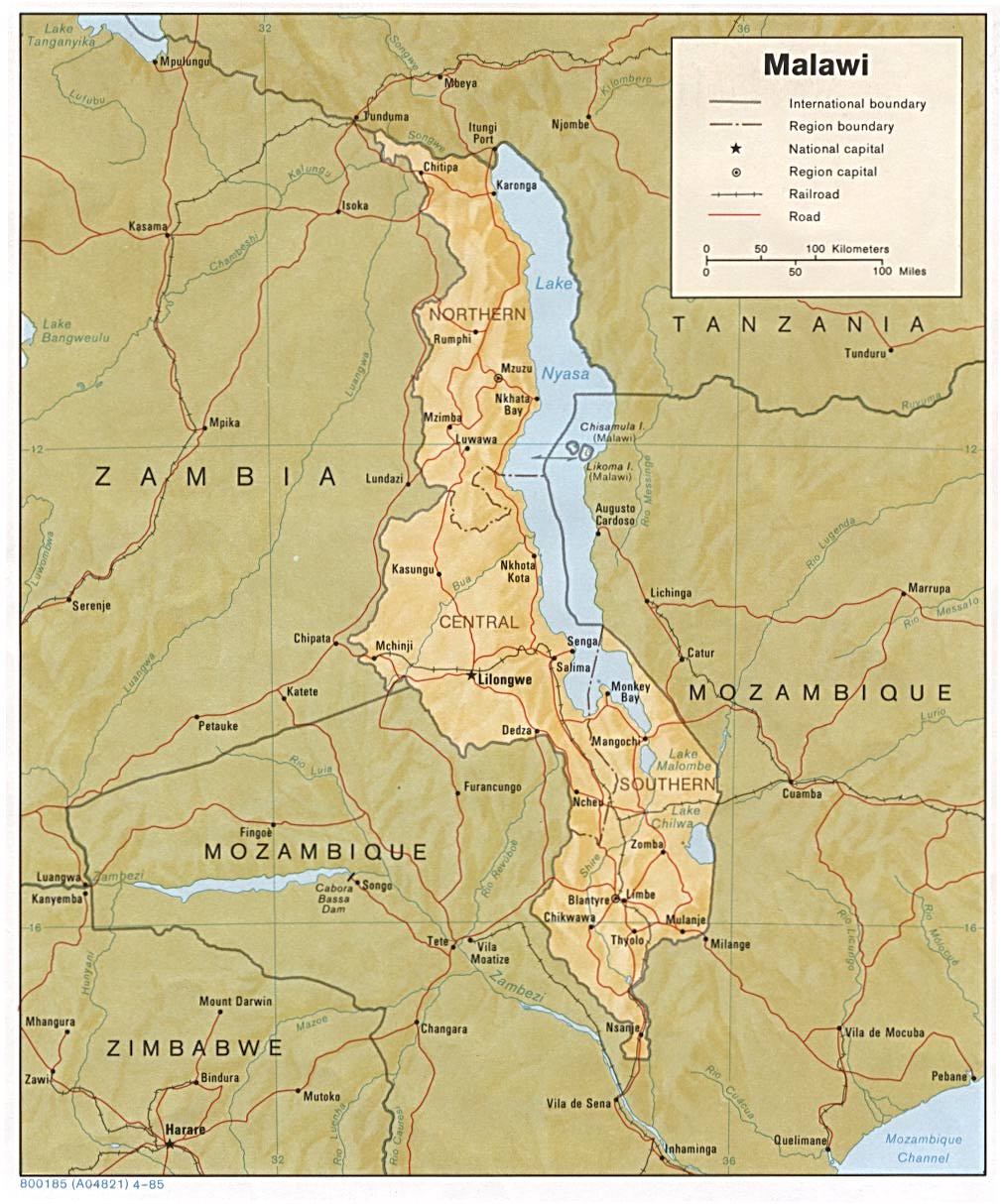
Malawi has an issues with Tanzania over the boundary in Lake Nyasa, aka Lake Malawi, and the Songwe River. Tanzania would be considered one of their allies during the current time.

Click here to see a map of Malawi: http://www.lib.utexas.edu/maps/africa/malawi.jpg

Thursday, March 1, 2007

President Carter's book

The book "Palestine: Peace Not Apartheid" has caused major controversy just starting at the title. When asked, President Carter stated that he used the words "Palestine" and "Apartheid" to try and generate interest in the book and to try and get people to read the book to find out the real facts. He uses the word "apartheid" suggesting that the analogy of the hated policies of South Africa is especially outrageous. Carter mentions failures on all sides in the book, including the Palestinians, Israel, and the U.S. However, it is extremely critical of Israel and its policies in the Palestinian territories. "It's based on a minority of Israelis occupying, confiscating and colonizing land that belongs to the Palestinians," Carter told The Early Show co-anchor Harry Smith. Carter places the majority of the blame on Israel for its continuing conflict with the Palestinians. It is causing major conflict by connecting Palestine with apartheid.
President Carter claims that the Palestinian Arabs have long supported a two-state solution and the Israelis have always opposed it. But overall, "Palestine: Peace Not Apartheid" is so biased that it without a doubt raises the question of why would a man like Jimmy Carter write such an indecent book. Whatever President Carter's motives may be, his authorship of this ahistorical, one-sided, and simplistic brief against Israel forever disqualifies him from playing any positive role in fairly resolving the conflict between Israel and the Palestinians. That is a tragedy because the Carter Center, which has done so much good in the world, could have been a force for peace if Jimmy Carter were as generous in spirit to the Israelis as he is to the Palestinians. President Carter took a big risk by writing this book and having the courage to speak out against the Israeli extremism that often is ignored by our American media and leaders.


Most of my information came from this site:

http://www.aish.com/societyWork/arts/Carters_Distorted_World.asp

No Logo

In the video, Naomi Klein explains how logos have taken over our marketing world and how logos are seen everywhere. Every time we turn around, we are seeing logos or name brand products on the media. She explains how we are constantly bombarded with advertisements and commercials. We cannot deny them or escape the logos in the world and they cannot be ignored. Marketing has grown into a competition and those who can market their product the best will become the most successful regardless of the product. This way the product becomes no longer the purpose, but they are selling you an idea or a way of life. This way they can technically sell us back to ourselves.
As far as connecting this to "The Yes Men", two men went to the WTO conferece to point out flaws in their ideas. Even though it was a ridiculous idea with the metallic suit and their invention of the suit, it wasn't about the suit itself. It comes down to how well you market the idea. Just as in Naomi's videos, she mentions that it is more about marketing the product more than the product itself.
The other major part of Naomi's video was the fact that producing goods needed to be done at the lowest possible cost. There is a global auction going on and the workers are the pawns. Wages are supposed to go up and the situation improve, but we are actually witnessing a race to the bottom where countries are outbidding each other to who can abuse their workers more. But in order for the company to save money, they have to control the workforce (workers are young and mostly women). We see in the advertisements the scenes and never normally the product.
As we have read about in the role of the State they are supposed to represent the interest of the dominant group. In Naomi's video, the multi-national corporations are the dominant groups. The jobs created by these multi-national corporations should not be held to the same standards as "real jobs." We see that even a story of globalization can be seen in by picking up a shoe, with leather from Argentina, shipped to Philippines, produced by Korean subcontractor, went through Hong Kong broker who was dealing with company in Oregon. In her video we see how globalization is viewed and how people around the world accept it. But we as students must see the affects of globalization on the world and see how we are affected by globalization and be able to form our own opinions on what is happening in the marketplace. Then we will be able to make better decisions on what to buy rather then just who does the best job of advertising or marketing.


Thursday, February 8, 2007

Klare-Blood and Oil

In listening to this portion on Klare takes a stance on his opinion of post 9/11. He begins by mentioning the focus of the Bush administration before and after 9/11. Before 9/11 he feels as though the Bush administration was focused on procuring more energy and resources for the United States. After 9/11 the focus turned to controlling terrorism and how to prevent terrorism from happening. Klare then turns his focus to the history of American Presidents and how their actions have impacted the current time.

He first mentions the great President Franklin D. Roosevelt and how he realized that the US was running out of a supply of oil and as our supply diminished we would loose power and prosperity. So he began to seek other countries with a great deal of oil to help the US out. In 1943, he decided that Saudi Arabia was the country with an abundant amount of oil and he made a pact with Saudi that the US would protect the “Royal Family” in exchange for privileged access to their oil supply. Up through the rankings of Presidents this agreement has withstood. Klare’s main argument here is that the US never seemed to be worried about the supply of oil until it was almost gone.

Then when Saddam Hussein invaded Kuwait, this threatened our supply of oil. The US was not the only offer to help save Kuwait. Osama Bin Laden offered to help Kuwait protect them from Saddam Hussein, which is a major shock to me. It seems weird that Bin Laden was the other offer to help out Kuwait and that we have had so many run-ins with Bin Laden. The permanent military presence of the US made Osama Bin Laden an enemy of the US. It all plays out and comes together to explain the reasons for 9/11. Klare explains 9/11 as a “natural consequence” to the US. He explains it as just a chain of events over time. I agree with Klare in this aspect and feel that over time the US paid the consequence for the price of oil. It all comes together in the end....

Tuesday, January 30, 2007

Ruling Class

The “power elite” according to William Domhoff is the group of upper class, those involved with large corporations, and those who are wealthy. These select few hold the decision making ability in their grip and hold the future of our society in their hands. I see the “power elite” as those who influence us through deciding on laws and guidelines that affect us as citizens. Not necessarily athletes or famous individuals as Dr. Johnson explained during a lecture. Athletes and famous actors/actresses have a certain amount of affect on one’s individual opinion on certain issues, but have no direct affect on how our society works. Those I believe to be in the “power elite” group would be President Bush for instance. According to Mills and Domhoff, both agree that power is owned by those who own the economy, high ranking CEO’s, etc. I feel that we must be very careful of who comes into power by these standards or the U.S. could definitely face some serious issues in the future.

Those in the ruling class seem to be born into the “power elite” status. As we have seen evidence, Bush family, those born into wealthier families are given a better education and are prepared to become politicians, leaders, and even Presidents. I believe that most of the ruling class is there because of their background and their past generations. Wealthy families are one step ahead of others as it takes a vast amount of money to become elected into any political position. It’s just a fact that all politicians must have money in order to be elected. We as a society have painted this poor picture of politicians and we must now accept the consequence. We have elected those into the power positions by which nominee we hear the most positive things about and which one we believe will do the best job based on their history. The ruling class benefits greatly from global conflict being thought of as inevitable. With filtered information going to the lower class standards, society seems to stand behind the decisions made about the conflicts, such as the war in Iraq. But not always is society getting the full background and total plan of what is happening. Some have decided not to support President Bush in any aspects, War in Iraq, No Child Left Behind, etc., but as far as I can tell I don’t feel that they are being totally honest with the public.

In our classroom, we are trying to accomplish a total understanding of global peace and global conflict and what we can do as individuals to help prevent certain actions from happening. To have a true opinion on the current issues in our society, we must have the true story or plan that is being pursued. With the filtration of information to the middle class society, we cannot truly understand the whole concept as we do not get the total view of what is about to happen. Understanding that we may not be receiving totally true or whole information that the ruling class provides us with can help us as students understand that we must us a variety of resources to fully understand a situation. I hope to use all my resources to understand situations and be able to decipher what is happening to our country.